Delhi: Researchers at the International Advanced Research Centre for Powder Metallurgy and New Materials (ARCI), Hyderabad, have developed a crack-free bi-metallic structure using advanced additive manufacturing technology. The development could reduce India’s dependence on imported superalloys while expanding applications in aerospace, nuclear and energy sectors.
A team of scientists from the International Advanced Research Centre for Powder Metallurgy and New Materials (ARCI), Hyderabad, has developed a new additive manufacturing process that enables the production of crack-free bi-metallic structures, a breakthrough that could reduce India’s reliance on costly imported superalloys.
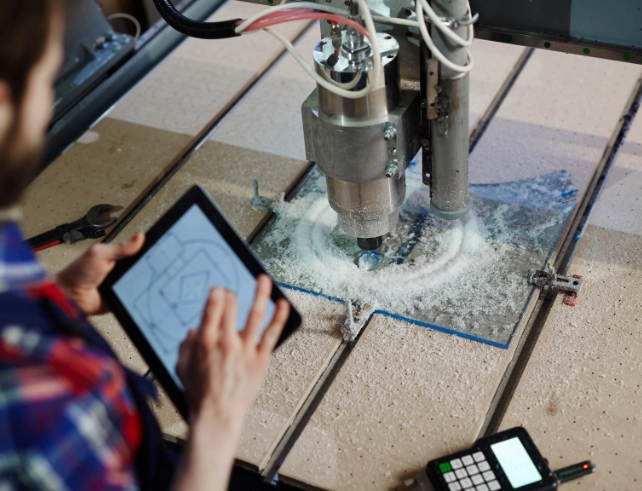
The research, carried out using laser-based powder bed fusion (PBF-LB/M) technology, addresses one of the longstanding challenges in joining stainless steel and nickel-based superalloys. These materials are widely used in aerospace, nuclear and thermal power applications, where components must withstand both high temperatures and corrosive operating conditions.
Conventional methods of joining stainless steel (SS316L) and Inconel 718 often encounter defects because the two materials differ significantly in their chemical composition, melting behaviour and thermal expansion characteristics. These differences can result in cracking, porosity and the formation of brittle intermetallic compounds, limiting their use in demanding industrial environments.
The ARCI researchers overcame these challenges by fabricating a bi-metallic structure through a laser-based powder bed fusion process while depositing material directly onto an Inconel 718 substrate. The resulting interface was free from visible cracks and pores, demonstrating strong metallurgical bonding between the two materials.
Performance testing showed the structure achieved an interface hardness of around 310 HV and an ultimate tensile strength of 550 ± 30 MPa. During tensile testing, failure occurred in the softer SS316L section rather than at the joint, indicating that the interface maintained its structural integrity under mechanical loading.
The study, conducted by S. Narayanaswamy, Gururaj Telasang, Nokeun Park and Ravi Babu, has been published in the journal Progress in Additive Manufacturing.
According to the researchers, the technology has potential applications in manufacturing boiler tubes, heat exchangers for nuclear and ultra-supercritical power plants, advanced energy systems, oil and gas processing equipment, and aerospace components. By placing expensive superalloys only where high-temperature performance is required, manufacturers could reduce material costs while improving component efficiency.
The development also demonstrates how additive manufacturing can support the production of multi-material engineering components, offering greater design flexibility for industries that require high-temperature strength and corrosion resistance without relying extensively on imported superalloys.
Source: This article is based on an official press release issued by the Press Information Bureau (PIB), Ministry of Science & Technology, Government of India
Press Release Page | Press Information Bureau