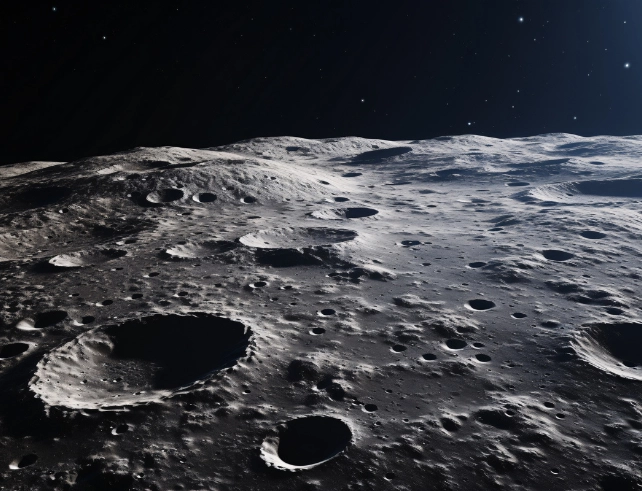
Using data from the Indian Space Research Organization’s Chandrayaan-2 mission, researchers from the Physical Research Laboratory in Ahmedabad have found compelling evidence of underlying ice in craters close to the Moon’s south pole.
The results are derived from observations made by the orbiter’s Dual Frequency Synthetic Aperture Radar (DFSAR), a cutting-edge microwave imaging device that can look beneath the lunar surface. Within a 1.1-km-wide crater inside the larger Faustini crater, researchers found strong evidence of subterranean ice.
Scientists claim that the crater also had a distinctive lobate-rim structure, indicating that the impact might have reached an ice-rich underlying layer. The finding adds to the mounting evidence that the polar regions of the Moon might have substantial subsurface water stores.
Operating since 2019, the Chandrayaan-2 orbiter has been instrumental in mapping the lunar polar topography and investigating the dielectric characteristics of the Moon. According to ISRO, the DFSAR instrument is the first fully polarimetric radar system that uses both L-band and S-band frequencies to examine the Moon.
The results may help future lunar missions since water-ice can be exploited to produce rocket fuel, oxygen, and drinking water during extended Moon exploration.
Source – The Economic Times