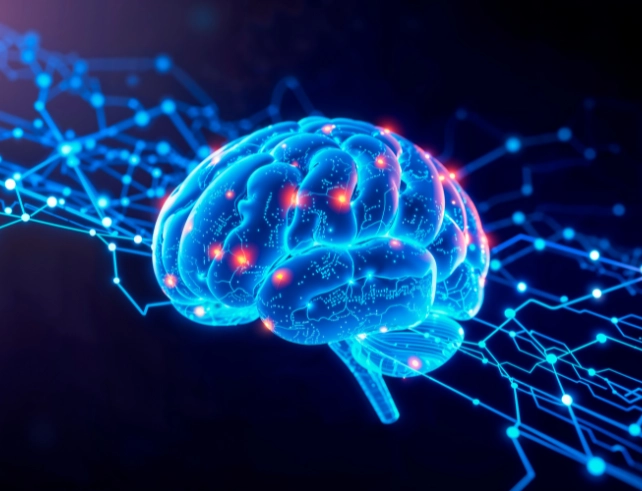
An innovative three-dimensional “mini-brain” chip that allows living neurons to communicate directly with electronic systems has been created by a team under the direction of Dr. Kumar Mritunjay. This represents a significant breakthrough in both artificial intelligence and neuroscience.
The novel platform closely resembles the structure and function of the human brain by enabling neurons to sprout in all directions within a 3D electronic scaffold, in contrast to conventional flat brain-on-chip models. Real-time, two-way communication between biological tissue and machinery is made possible by embedded sensors’ ability to both monitor and trigger brain activity.
Researchers can examine how neural connections change—a crucial component of learning and memory—because the system can maintain steady neuronal activity for long stretches of time. Its programmable nature also makes it possible to train biological neural networks with actual brain cells, much like AI systems.
According to experts, the breakthrough could improve brain-machine interfaces, speed up research into neurological illnesses, and open the door for hybrid computing systems that combine electrical precision and biological efficiency.
With broad implications for upcoming scientific and technical advancements, the development, which is now in the research stage, represents a major step toward combining biology and technology.
Source – India Today