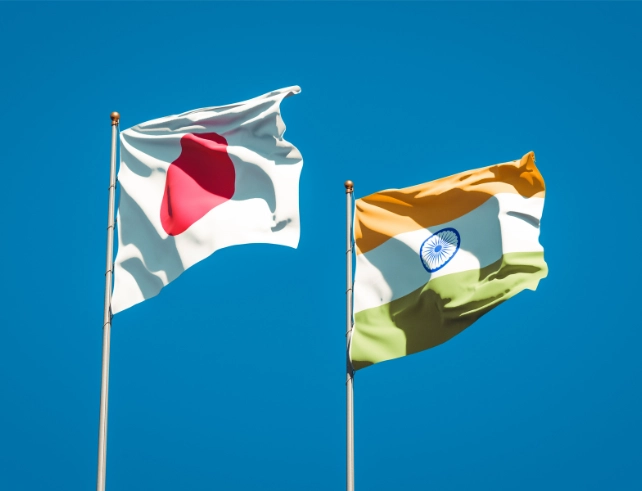
Delhi: India and Japan have unveiled a wide-ranging set of 16 outcomes following the 16th India-Japan Annual Summit, expanding cooperation across economic security, artificial intelligence, energy resilience, critical minerals, mobility, biotechnology, finance and digital infrastructure. The agreements aim to strengthen bilateral collaboration while supporting innovation, industrial growth and resilient supply chains.
The outcomes announced after the summit reflect a broader effort by both countries to deepen their strategic partnership across emerging technologies, manufacturing and economic cooperation.
A key development is the India-Japan Joint Declaration on Economic Security, which focuses on project-based collaboration in sectors such as semiconductors, critical minerals, information and communication technology, artificial intelligence, energy and pharmaceuticals. The declaration is supported by the India-Japan Fact Sheet 2.0, which outlines expanding government-to-government and business-to-business engagement.
The two nations also signed a Joint Statement on Cooperation in Artificial Intelligence, establishing a roadmap for collaboration across the AI ecosystem, including research, innovation and trusted AI development. Another joint statement on Energy Resilience seeks to strengthen cooperation in strategic petroleum reserves and investments linked to maritime energy transport.
Several memorandums of cooperation were signed to advance collaboration in priority industries. These include initiatives covering compressed biogas, battery technologies, pharmaceuticals and medical devices, and critical mineral exploration. The agreements are intended to support industrial partnerships, technical cooperation and resilient supply chains.
Innovation and advanced research featured prominently in the summit outcomes. India and Japan agreed to strengthen cooperation between research institutions in areas including cellular and molecular platforms, biological sciences, neuroscience, large language models and foundation AI models. The initiatives are expected to promote joint research, academic exchanges and startup-driven innovation.
The summit also expanded collaboration in digital infrastructure and governance. Agreements involving the IndiaAI Mission, Japan’s GENIAC initiative, the National Internet Exchange of India (NIXI) and Japan Network Information Center (JPNIC) will support AI policy dialogue, internet governance, cybersecurity, IPv6 adoption and technical exchanges.
In the financial sector, the International Financial Services Centres Authority (IFSCA) and Japan’s Financial Services Agency (JFSA) agreed to establish a framework for cooperation on financial regulation, FinTech and RegTech, while another agreement operationalises the Next Generation Mobility Partnership, aimed at accelerating cooperation in railways, automotive, aviation, ports, logistics and urban development.
The outcomes also include preparations to commemorate the 75th anniversary of India-Japan diplomatic relations in 2027, highlighting the continued expansion of bilateral ties across strategic and economic sectors.
Source: This article is based on an Official press release issued by the Press Information Bureau, Prime Minister’s Office, Government of India
Press Release Page | Press Information Bureau