West Asia conflict raises concerns for Indian markets, impacting oil prices, trade flows, industry stability, and long-term energy security.
25


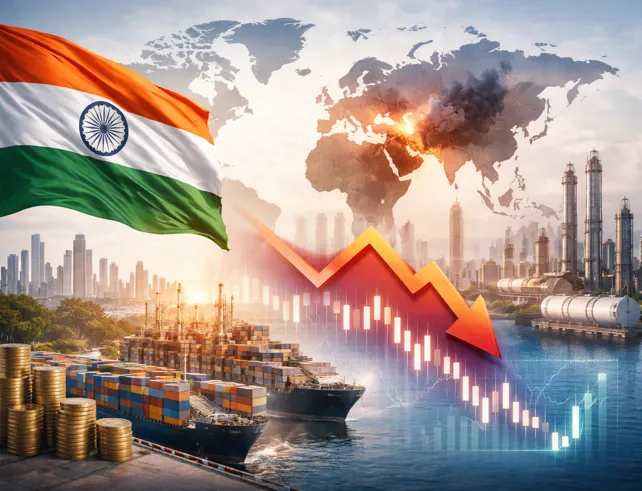 The ongoing conflict in West Asia is beginning to reflect beyond geopolitics and into real economic impact. For India, the situation is closely linked to energy security, supply chain continuity and industrial stability.
In recent statements in Parliament, Prime Minister Narendra Modi emphasized India’s position focused on dialogue, diplomacy and de-escalation. At the same time, Finance Minister Nirmala Sitharaman has highlighted the need to strengthen domestic energy output and reduce external dependency. Together, these signals point to a dual approach: managing immediate disruptions while building long-term resilience.
India’s economic structure is deeply connected to global trade routes and energy imports. A large share of crude oil, LPG and fertilizers flows through the Strait of Hormuz, making the region strategically critical.
With tensions affecting maritime routes:
For Indian businesses, this translates into cost pressure and planning challenges across sectors.
The most immediate impact is visible in the energy sector. Any disruption in crude supply affects refining, distribution and industrial consumption.
For industries:
India’s move to diversify energy imports from 27 to 41 countries is a key step in reducing this risk.
Sectors such as metals, cement, chemicals, and engineering are directly dependent on stable energy supply.
Impact areas include:
However, companies investing in automation, energy-efficient drives and optimized production systems are better positioned to absorb these shocks.
Fertilizer availability is closely linked to global gas markets. Any disruption can impact sowing cycles and agricultural output.
From a market perspective:
The government’s assurance on fertilizer availability highlights the importance of this sector in crisis response.
Over 90 percent of India’s trade is carried via maritime routes, largely dependent on foreign vessels.
Current risks include:
In response, the government’s investment in domestic shipbuilding is a strategic move to strengthen long-term control over logistics infrastructure.
India’s response is not limited to short-term crisis management. It reflects a broader structural shift.
Key focus areas include:
This aligns with the larger vision of self-reliance while maintaining global trade integration.
This situation brings a clear message for industry leaders and decision-makers.
Rising energy costs make efficient systems, drives and automation solutions essential for cost control.
Dependence on single geographies or suppliers is increasingly risky. Businesses need multi-source strategies.
Domestic manufacturing is no longer just policy-driven. It is becoming a competitive advantage.
Digital monitoring, predictive maintenance and automation will help industries manage uncertainty better.
Despite current disruptions, India’s economic fundamentals remain stable. The government’s focus on short, medium and long-term strategies indicates preparedness for evolving scenarios.
At the same time, this crisis is accelerating key transitions:
In my view, this situation is less about short-term disruption and more about long-term correction.
It is pushing India towards a more resilient, diversified and technology-driven industrial ecosystem.
Businesses that adapt early, especially in energy management, automation and supply chain strategy, will be better positioned to navigate not just this crisis, but future uncertainties as well.
Reference

